What Is the House of Representatives the Senate
About the House of Representatives
The Firm of Representatives is one of the two houses of the Australian Federal Parliament, the other being the Senate. It is sometimes called the 'people's house' or the 'house of government'.
Composition
The House currently has 151 Members. Each Member represents an electoral partitioning. The boundaries of these electorates are adjusted from time to time then that they all contain approximately equal numbers of electors—because of the distribution of Australia'southward population they vary greatly in area (from a few square kilometres to over 2 1000000 foursquare kilometres). Members are elected past a organization known as preferential voting, nether which voters rank candidates in society of preference.
Each House of Representatives may keep for upwardly to three years, later which general elections for a new Firm must be held. Elections are ofttimes held before the stop of this menstruation.
The master political parties represented in the Firm are the Australian Labor Political party, the Liberal Party of Australia and the National Political party of Australia. In recent years there has also been a number of contained parties and Members.
Run into also:
- Infosheet viii – Elections for the House of Representatives
Functions
Makes laws—The House's primal function and the one which takes up most of its fourth dimension is the consideration and passing of new laws and amendments or changes to existing laws. Whatever Member can introduce a proposed constabulary (bill) but most are introduced by the Government. To become law, bills must be passed by both the House of Representatives and the Senate. They may starting time in either house but the bulk of bills are introduced in the Firm of Representatives.
Determines the Government—After an election the political party (or coalition of parties) which has the most Members in the House of Representatives becomes the governing political party. Its leader becomes Prime Minister and other Ministers are appointed from among the political party'due south Members and Senators. To remain in part a Government must keep the support of a majority of Members of the Business firm.
Publicises and scrutinises government assistants—Debate of legislation and ministerial policy statements, discussion of matters of public importance, committee investigations, asking questions of Ministers (during question fourth dimension—at 2 pm—Members may enquire Ministers questions without observe on matters relating to their work and responsibilities; questions can also exist asked on notice for written respond).
Represents the people—Members may present petitions from citizens and raise citizens' concerns and grievances in debate. Members also heighten issues of concern with Ministers and regime departments.
Controls regime expenditure—The Authorities cannot collect taxes or spend money unless allowed past police through the passage of taxation and cribbing bills. Expenditure is too examined past parliamentary committees.
See too:
- Infosheet 19 – the Business firm, Government and Opposition
Sittings
The normal sitting pattern for the House extends from Feb to March, May to June and Baronial to Dec. During these periods the House normally meets in blocks of two sitting weeks followed by two non-sitting weeks. Normally the House sits from Mon to Thursday each sitting calendar week.
The order of business for each sitting is set down by the rules of the Business firm (the House of Representatives Standing and Sessional Orders). The largest proportion of time is taken upwardly with debate on authorities business organisation—mainly the consideration of bills. On Mon, 'individual Members' day', time is reserved for debating reports from parliamentary committees and concern sponsored by both government and non-regime backbenchers.
All proceedings are open to the public.
Come across also:
- Infosheet2 – A typical sitting day
- Sitting agenda
Committees
The Firm has a comprehensive system of continuing committees. These include:
-
investigative committees—These committees bear out inquiries on matters of public policy or government administration. They take show from the public and report to the House with recommendations for government action. The system of full general purpose standing committees parallels the functions of authorities, for example, Aboriginal and Torres Strait Islander Diplomacy; Economics, Finance and Public Assistants; Pedagogy and Vocational Training; and
-
domestic or internal committees—These committees are concerned with the operation of the House, for example, Procedure, Privileges, Members' Interests.
There are several joint committees on which both Members and Senators serve together, for example, the Public Accounts and Audit Committee.
See also:
- Infosheet iv – Committees
The Bedchamber
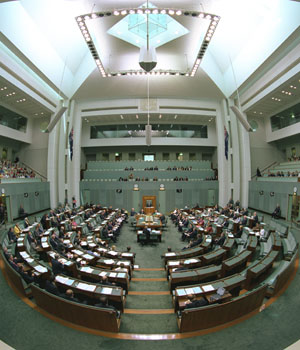
The photograph at left shows the Sleeping room of the House in action.
At the center is the Speaker'due south Chair and the Table of the Firm. The 2 Clerks at the Table advise the Chair and Members about procedure and record the formal minutes of proceedings. Hansard reporters sit at the modest central table to record the debates. Each Member has his or her ain seat, with regime Members to the right of the Speaker and opposition and other non-regime Members to the left. Ministers and senior opposition Members (the shadow ministry) sit on the facing front benches and speak from the Table, other Members speak from their places.
With the exception of question time, Members are rarely all present in the Bedchamber at the same fourth dimension, but are engaged in work elsewhere, including participating in committee meetings and debates in the Chief Committee. Members can sentry what is happening in the Chamber at all times from their offices through the Parliament Business firm internal tv set system.
Behind the Speaker'due south Chair at offset floor level is the printing gallery, reserved for media representatives. On the other three sides of the Chamber are the public galleries, which are always open to visitors.
See besides:
The Federation Bedchamber
The Federation Chamber provides an additional forum for the second reading and consideration in detail stages of bills and debate of committee reports and papers presented to the House. 1 of the Business firm of Representatives commission rooms is dedicated to this function and fitted out as a small-scale-scale Chamber. Its proceedings are too open up to the public.
See as well:
- Infosheet xvi – The Federation Chamber
The Speaker
The first action of the Firm following an election is to elect one of its Members to be Speaker. The Speaker presides over the sittings of the House and is responsible for its administration. The Deputy Speaker and Second Deputy Speaker are also elected. A panel of other Members, appointed by the Speaker, provides assistance in presiding over the House and the Main Committee. When in the Chair these Members are referred to as 'Deputy Speaker'.
See also:
- Infosheet 3 – The Speaker
Inter-Parliamentary Relations
The International and Parliamentary Relations Office (IPRO) provides advice and support relevant to the deport of the Parliaments international and regional diplomacy. Information technology provides general support for inter-parliamentary conferences and incoming and approachable parliamentary delegations; training support for other parliaments, particularly the smaller parliaments in our region; and communication to the Presiding Officers and members on international parliamentary matters.
The IPROs objective is to support external relations for the Parliament with a view to achieving productive and amicable international and regional relationships with other parliaments and parliamentary bodies and organisations.
thwaitescounsis1949.blogspot.com
Source: https://www.aph.gov.au/About_Parliament/House_of_Representatives/About_the_House_of_Representatives
0 Response to "What Is the House of Representatives the Senate"
Post a Comment